Cabin crew interview questions fall into five predictable groups: why you want the job, behavioural "tell me about a time" questions, situational and safety scenarios, a group exercise, and practical questions about relocation and commitment. Below are the questions you will actually hear in each group, the thing the recruiter is really testing, and how to answer so you do not get cut. Reading them is the easy half. Saying your answers out loud, under a little pressure, is what actually gets you ready.
Last updated 7 July 2026. AeroScout tracks 191 live cabin crew roles right now, and Avienne, our practice interviewer, has already run hundreds of mock interviews with aspiring crew.
The questions at a glance, and what each one is really testing
Almost every cabin crew interview question is a proxy for a small number of qualities: safety instinct, warmth, teamwork, composure, and honest self awareness. Once you can see what a question is really testing, you stop guessing and start answering the thing behind it. This table is the fastest way to learn that map.
| Question you will hear | What they are really testing | The answer that gets you cut |
|---|---|---|
| Why do you want to be cabin crew? | Genuine service orientation, not wanderlust | "I want to travel and see the world." |
| Why this airline? | Whether you did real research | Anything you could say about any airline |
| Tell me about a time you handled a difficult customer. | How you behave under pressure, with proof | A vague claim with no specific moment |
| A passenger refuses a safety instruction. What do you do? | Whether you hold the rule and escalate | Keeping the passenger happy at all costs |
| How do you feel about relocating and irregular hours? | Realistic expectations about the life | Pretending it will never be hard |
| What is your biggest weakness? | Honesty and self awareness | "I am a perfectionist." |
1. Motivational questions: why this job, and why this airline
These open almost every interview, and they are where most candidates lose the room in the first two minutes. Common versions include: Why do you want to be cabin crew? Why do you want to work for us? Why are you leaving your current job? What does good customer service mean to you?
The recruiter is listening for genuine service orientation and real research, not enthusiasm for free travel. The answer that sinks people is "I want to travel and see the world." Everyone says it, and it tells the recruiter nothing about how you will treat a nervous passenger at two in the morning. Anchor your answer in the work itself, caring for people in a small space over long hours, and in something specific about that airline: its network, its reputation for service, its home base. When they ask why you are leaving your current job, stay positive and forward looking. Never criticise a past employer, because they are testing how you will talk about them one day.
2. Behavioural questions: "tell me about a time..."
This is the heart of the interview and the part you can improve the most. The recruiter asks for real stories because how you behaved before predicts how you will behave onboard. The usual set: tell me about a time you dealt with a difficult customer, worked in a team, handled conflict with a colleague, went above and beyond, made a mistake, or had to follow a rule you did not agree with.
Answer every one of these with STAR, which stands for Situation, Task, Action, Result. It turns a vague claim into a concrete story a recruiter can actually score. Here is a weak answer to "tell me about a time you went above and beyond":
"I always go the extra mile for people. I really care about doing a good job, so I go above and beyond all the time in my work."
It sounds fine and proves nothing. Now the same answer in STAR:
"Working reception at a hotel, an elderly guest arrived late and distressed because her connecting details were wrong and she had no room booked. My job was just to check people in, but I could see she was close to tears. I sat her down with a tea, called three nearby hotels until I found her a room, wrote out her directions, and arranged a taxi. She wrote to my manager the next week, and we started keeping a short list of backup hotels for exactly that situation."
Same person, same experience, completely different result. The second answer wins because it names a real moment, shows a decision made without being told to, and ends in a concrete outcome. Prepare four or five of these stories before any interview, one for each common theme, and you will have something ready for almost anything they ask.
3. Situational and safety questions: "what would you do if..."
Here is what most candidates miss, and it is the single biggest thing that separates people who get hired. Cabin crew is legally a safety role before it is a service role. In Europe this sits under EASA Part-CC. So when a recruiter describes a scenario, they are watching whether your instinct is safety first.
Typical questions: What would you do if a passenger refused to fasten their seatbelt? If two passengers were arguing over a seat? If someone appeared intoxicated and wanted another drink? If a colleague was not pulling their weight during a busy service? The winning shape is almost always the same. Stay calm, address the person with warmth and respect, hold the safety rule without apology, and involve the senior crew rather than trying to solve everything alone. If your answer is only about keeping the passenger happy, you have failed the test. If it is only about enforcing rules coldly, you have failed the other half. They want both, in that order.
4. The group exercise
Many airlines run a group task on the assessment day, and they are scoring the process, not the answer. Do you listen before you speak, bring quieter people into the discussion, and stay calm when it gets busy? Dominating the conversation gets people cut just as fast as saying nothing at all. Treat the other candidates as future colleagues, not competition. The recruiter walking the room is noting who makes the group work better, because that is exactly what a good crew member does at 35,000 feet.
5. Commitment and the practical questions
Near the end you will get the practical ones: how do you feel about relocating, about time away from home, about irregular hours and early starts? Are you comfortable with the grooming and reach standards? These are not trick questions, but honesty matters. The airline is about to invest weeks of training in you, and it wants people who understand the life and still want it. Show that you have thought it through realistically rather than promising it will never be hard. Someone who admits the lifestyle takes adjustment and still wants the job is far more convincing than someone who pretends it is all glamour.
The trap questions, and how to stay honest
A few questions exist mainly to test whether you are genuine: what is your biggest weakness, how would your friends describe you, where do you see yourself in five years. The classic mistake is the fake weakness, "I am a perfectionist," which every recruiter has heard a thousand times and reads as evasive. Name a real, non disqualifying weakness and show what you are doing about it. Self awareness reads as maturity, and maturity is exactly what they are hiring for in a role where you may one day manage a cabin in a crisis.
Meet Avienne, your practice interviewer
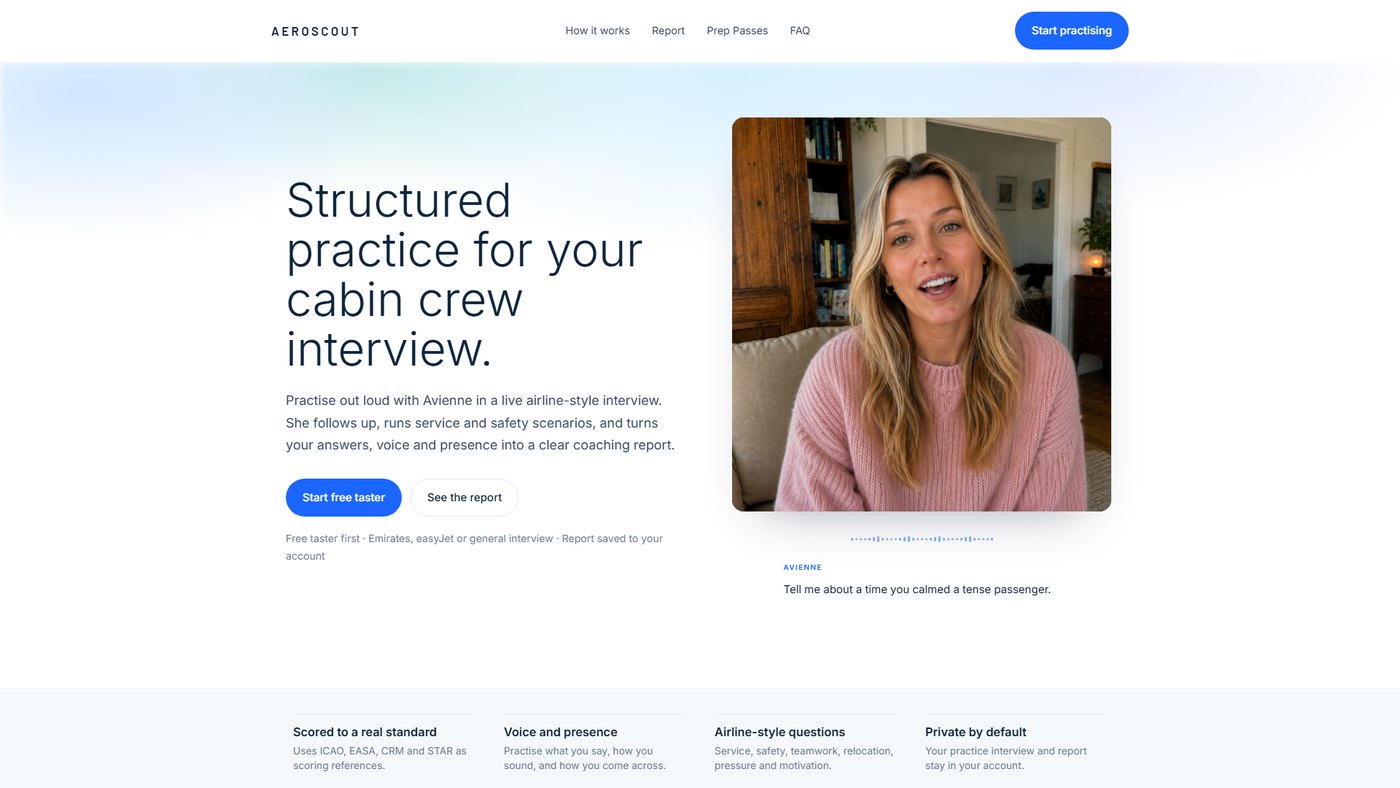
Knowing the questions on a page is only recognition. The interview tests performance, and the gap between the two is where good candidates get caught out. Avienne closes that gap. She is a live practice interviewer you talk to out loud, from your laptop, exactly as you would in the real room.
What makes her different is where the questions come from. Avienne is not built on generic advice copied off a blog. We collect real questions and feedback from cabin crew who have actually sat through these interviews and assessment days, and Avienne is built on that, growing every time more crew share what came up. She runs a full interview the way a recruiter would: a warm opening, behavioural questions that follow up on your actual answers instead of reading from a fixed list, and a situational role play. Each run is short on purpose, never longer than 20 minutes, so a full interview and your feedback fit into a coffee break.

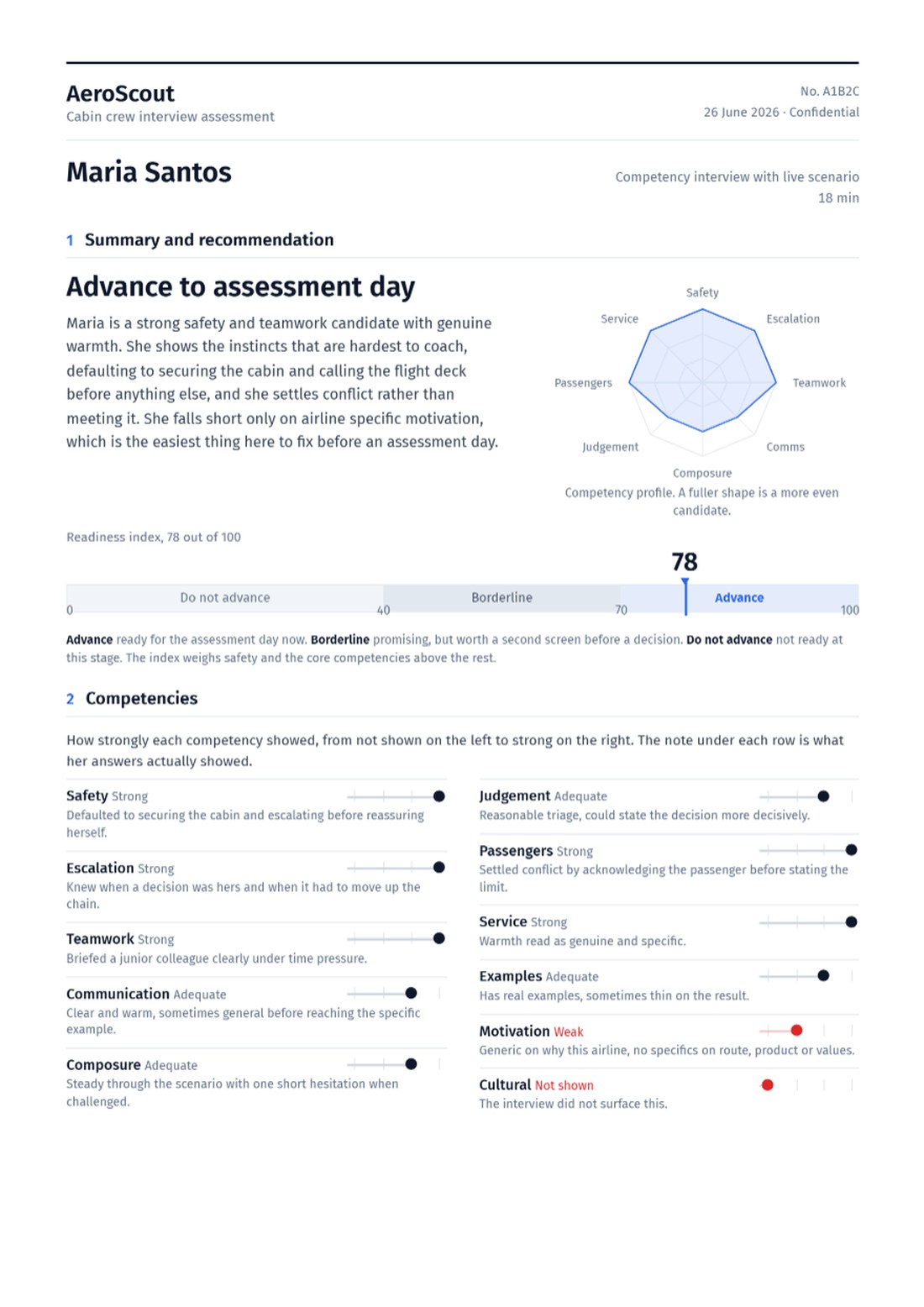
The feedback is the part that changes results. At the end you get a report that scores both what you said and how you said it: whether your stories were specific, whether your safety instinct showed, and how your pace, eye contact and composure came across on camera. It opens with a plain recommendation on whether you are ready, gives you a readiness score, and breaks down every competency an airline will judge, each with a short note on what your answer showed and what to sharpen. Then you do it again, as many times as you need.
Hundreds of aspiring crew have already practised with Avienne, and the feedback has been consistently positive, because reps with feedback are simply how people get good at interviews. You can start with a free taster and hear how she runs before you commit to anything.
Practise these questions out loud with Avienne →
A simple way to use these questions this week
Do not just read the list again. Write out four or five real stories from your own work history in STAR shape, one each for a difficult customer, a team under pressure, a conflict you handled, a time you went above and beyond, and a time you followed a rule that mattered. Then run a full mock interview with Avienne out loud, read the report, fix the single weakest thing, and run it again. A few focused reps across a week will do more than a month of reading, because on the day you will not be reading. You will be speaking, and that is the only skill that counts.
Frequently asked questions
What are the most common cabin crew interview questions? The most common are motivational (why cabin crew, why this airline), behavioural (tell me about a time you handled a difficult customer or worked in a team), situational and safety scenarios (what would you do if a passenger refused a safety instruction), a group exercise, and practical questions about relocation and irregular hours. Almost every question you face is a version of one of these.
How do you answer "why do you want to be cabin crew?" Anchor it in the work, caring for people in a demanding environment, and in something specific about that airline. Avoid "I want to travel," which every recruiter hears and which says nothing about how you treat passengers. Show genuine service orientation and that you understand it is a safety role, not a holiday.
What are behavioural questions in a cabin crew interview? Behavioural questions start with "tell me about a time" and ask for a real example from your past. They exist because how you behaved before predicts how you will behave onboard. Answer them with the STAR structure: Situation, Task, Action, Result, built around one specific moment rather than a general claim.
How do you answer "tell me about a time" questions? Use STAR. Set the scene briefly, say what your responsibility was, describe the specific actions you took, and finish with a concrete result. Prepare four or five of these stories in advance covering the common themes, and practise them out loud so they come out naturally under pressure instead of sounding rehearsed.
What safety questions are asked in cabin crew interviews? Expect scenarios like a passenger refusing to fasten a seatbelt, an intoxicated passenger, or two passengers in conflict. Cabin crew is a safety role first, so the recruiter wants to see that you stay calm, hold the rule with warmth, and involve the senior crew rather than solving everything alone or simply keeping the passenger happy.
How do you answer the biggest weakness question for cabin crew? Name a real, non disqualifying weakness and show what you are doing about it. Avoid "I am a perfectionist," which reads as evasive. Recruiters are testing honesty and self awareness, so a genuine answer with evidence of growth is far stronger than a polished non answer.
How do you answer "why this airline?" Do real research and name something specific: the network, the home base, the service reputation, the training. If your answer could apply to any airline, it fails. The recruiter is checking whether you actually want them or just want the uniform.
Can I practise cabin crew interview questions out loud? Yes. You can run a full interview out loud with Avienne from your laptop, get scored on both your answers and your delivery, and repeat it as many times as you need before the real thing. There is a free taster so you can hear how it works first.
Published by AeroScout. Browse our live cabin crew roles, read our companion guide on how to prepare for a cabin crew interview, or start practising with Avienne.