The best way to prepare for a cabin crew interview is not to read another list of questions. It is to answer real questions out loud, under a little pressure, and be told exactly what to fix. Reading builds recognition. The interview tests performance. This guide covers how a cabin crew selection process actually flows, the questions you will face, the mistakes that quietly get people cut, and a practice plan that gets you ready to walk in warm.
Last updated 1 July 2026. AeroScout tracks 190 live cabin crew roles right now, and Avienne, our practice interviewer, has already run hundreds of mock interviews with aspiring crew.
The three ways people prepare, and why only one gets you ready
Most candidates prepare by reading. Reading is comfortable and it feels like progress, but it trains the wrong thing. On the day you do not get to read. You have to speak, choose a real example in a few seconds, keep your voice steady, and hold eye contact while you do it. That is a different skill, and the only way to build it is to rehearse the way you will perform.
| How you prepare | What it builds | Feedback you get | Trains your delivery |
|---|---|---|---|
| Reading question lists | Recognising the questions | None | No |
| Watching interview videos | A feel for the format | None | No |
| Practising out loud with Avienne | Answering under pressure | A scored report on every answer | Yes: pace, eye contact, composure |
What a cabin crew selection process actually looks like
A cabin crew interview is rarely just one conversation. Most airlines run a sequence of stages and cut candidates after each one, so it helps to know the shape before you walk in. The exact order and names change from airline to airline, but the flow is remarkably consistent.
It usually starts online. You submit an application, often with specific photos and your work history, and many airlines then send a short recorded video interview where you answer a few questions to a camera with no interviewer on the other end. This is a real gate, and people fail it by treating it like a casual video call: rushed pacing, flat tone, weak eye contact with the lens.
If you pass the online stage, you are invited to an assessment day in person. A typical day runs several hours and moves through a presentation about the airline and the job, one or two group exercises, a reach and height check against a marked wall, and an English test that is often the single biggest cut. Some airlines add a personality questionnaire. Between stages, some candidates are asked to leave, which is why composure across the whole day matters as much as any single answer.
The decisive stage is usually a final interview, often one on one, frequently scheduled on a later date. It is mostly behavioural, built around your real work history, and this is where the offer is genuinely won or lost. Knowing this map matters, because it tells you where to spend your preparation: the recorded video, and the behavioural final interview, are the two stages you can most improve by rehearsing out loud.
The questions cabin crew actually get asked
This is where Avienne is different. It is not built on generic interview advice copied off a blog. We collect real questions and feedback from cabin crew who have actually sat through these interviews and assessment days. Avienne is built on that, and it grows every time more crew share what came up.
When you read across all of that feedback, the same handful of question types shows up again and again, whatever the airline. Learn these and you can handle almost anything they put in front of you, even a question you have never heard word for word.
1. Motivational: why this job, and why this airline. They want genuine service orientation and real research about the airline. The answer that sinks people is "I want to travel and see the world." Everyone says it, and it tells the recruiter nothing about how you treat a passenger. Give them a reason rooted in the work itself and in something specific about that airline.
2. Behavioural: "tell me about a time..." This is the heart of the interview. Recruiters ask for real stories because how you behaved before predicts how you will behave onboard. Answer with STAR, covered in full below. The most common failure is giving a vague, general answer when they asked for one specific moment.
3. Situational and safety scenarios: what would you do if... Here is what most candidates miss. Cabin crew is legally a safety role before it is a service role; in Europe this sits under EASA Part-CC. So when they describe a passenger refusing a safety instruction, they are watching whether you hold the rule under pressure and bring in the senior crew, not whether you keep everyone happy.
4. The group exercise. Many airlines run a group task. They are scoring the process, not the answer: do you listen before you speak, bring quieter people in, and stay calm. Dominating the discussion gets people cut just as fast as saying nothing.
5. Commitment and the practical realities. Relocation, shift patterns, time away from home, the reach and grooming standards. They want to see realistic expectations, not someone who will be surprised later.
None of this is guesswork. Every one of these patterns came out of what real cabin crew told us about their own interviews, and it is exactly what Avienne practises with you, drawn straight from the questions and follow ups they actually faced.
The STAR method, with a worked example
Behavioural questions are the ones you can most improve, and STAR is how you do it. STAR stands for Situation, Task, Action, Result. It turns a vague claim into a concrete story a recruiter can score.
Here is a weak answer to "tell me about a time you handled a difficult customer":
"I am good with difficult customers. I always stay calm and make sure they leave happy. Customer service is really important to me and I have a lot of experience with it."
It sounds fine and says nothing. There is no moment, no action, no proof. Now the same answer in STAR:
"In my last job at a busy coffee shop, a customer came back furious that his order was wrong during the morning rush. I needed to fix it quickly without holding up the queue or making him feel dismissed. I stepped to the side with him so I was not talking over other customers, apologised without making excuses, remade the drink myself straight away, and quietly told the barista so it would not happen again. He calmed down, thanked me on his way out, and came back the next week. My manager later used it as an example in our team briefing."
Same candidate, same experience. The second answer wins because it is specific, it shows a decision under pressure, and it ends in a real result. Prepare four or five of these before any interview and you will have a story ready for almost anything they ask.
What recruiters are really scoring
Behind the questions, recruiters are grading a short list of qualities. Knowing them tells you what every answer should quietly demonstrate.
Safety instinct comes first, because the job exists to keep passengers safe. They want to see that you would hold a safety rule under pressure and escalate to senior crew rather than handle everything alone. Communication is next: clear, warm, and calm, with genuine listening rather than a rehearsed script. Teamwork matters, but the specific test is whether you can contribute without taking over. Composure runs through the whole day, because assessors watch your body language and steadiness as closely as your words. Service orientation should feel real, not performed. And honesty threads through all of it, which is why recruiters reject tired clichés like naming perfectionism as your only weakness. They are testing whether you are genuine, not whether you memorised the right lines.
Why good candidates still get cut
Talent is rarely the problem. The same avoidable mistakes come up again and again:
- They tell instead of show, with no specific example behind the claim.
- They forget it is a safety job and answer everything as pure service.
- They lean on the travel cliché instead of a reason rooted in the work.
- They dominate or disappear in the group task.
- Their delivery lets them down: rushing, filler words, losing eye contact when the pressure rises.
Every one of these is fixable, but only if someone points it out to you before the real interview does.
How Avienne gets you ready
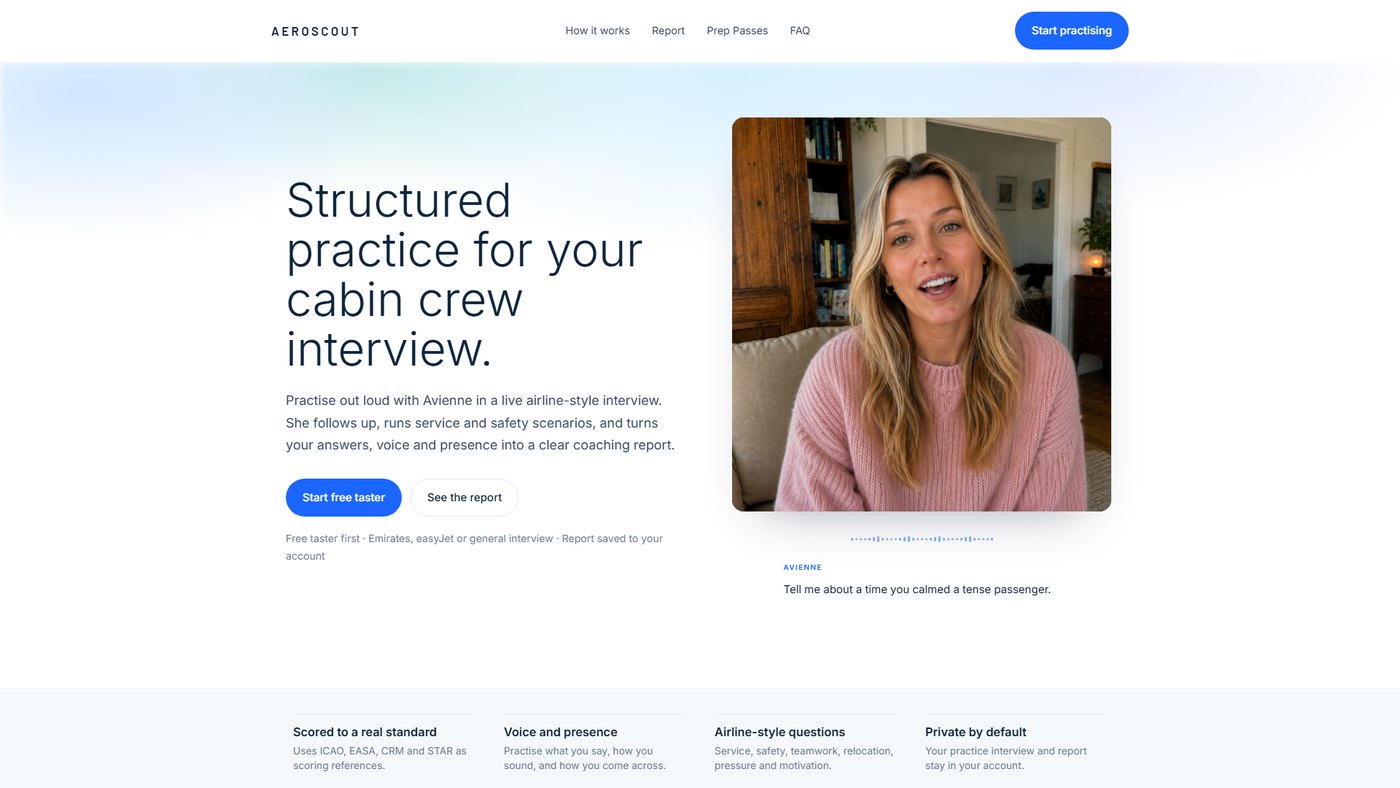
Avienne is a live practice interviewer built for exactly this. It is built on the real questions candidates get asked in cabin crew interviews and assessment days, and we keep it current with what people report from recent interviews. It runs a full interview the way a recruiter would: an opening, behavioural questions that follow up on your actual answers, and a situational role play. Each interview is short on purpose, never longer than 20 minutes, so a full run and your feedback fit into a coffee break.

The feedback is the part that changes results. At the end you get a report that scores both what you said and how you said it: whether your stories were specific, whether your safety instinct showed, and how your pace, eye contact and composure came across on camera. Then you do it again. Hundreds of aspiring crew have already practised with Avienne and the feedback has been consistently positive, because reps with feedback are simply how people get good at interviews.
The report is a single clear page. It opens with a plain recommendation on whether you are ready, gives you a readiness score, and then breaks down every competency an airline will judge, from safety and teamwork to how specific your examples were. Each one comes with a short note on what your answer actually showed and what to sharpen before the real thing.
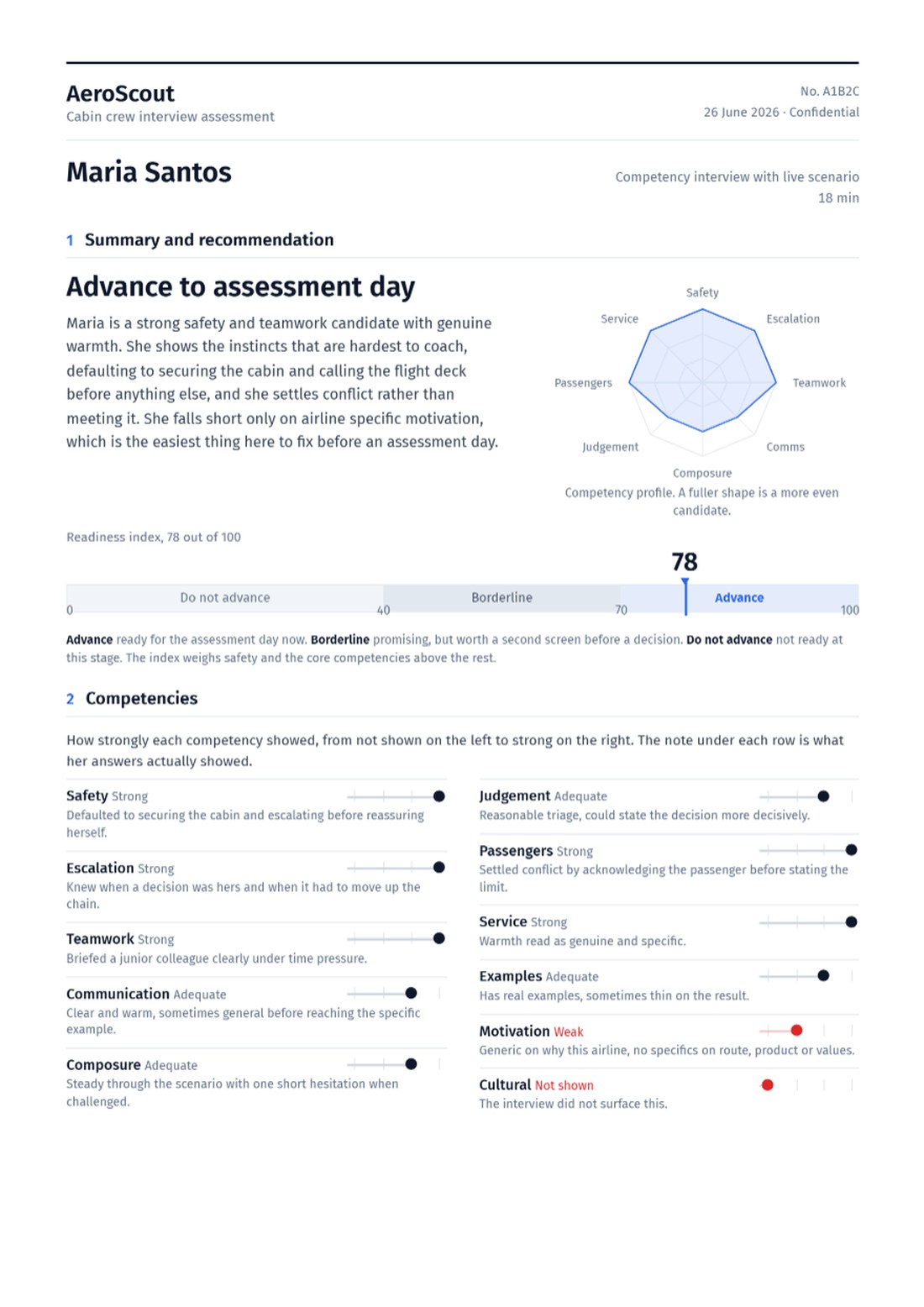
You get unlimited runs, so you can practise until walking into the real room feels familiar.
A simple plan for your last two weeks
You do not need a month. You need focused reps in the right order.
Spend the first few days writing out four or five real stories from your work history, one for each common theme: a difficult customer, working in a team, handling conflict, going above and beyond, and a time you followed a rule that mattered. Shape each one with STAR.
Then move to rehearsal, out loud, not in your head. Run a full mock interview with Avienne, read the report, fix the single weakest thing, and run it again. Repeat across several days so each run is a little sharper than the last.
In the final stretch, drill the situational and safety questions and talk through one group scenario, since those are the ones people rehearse least. In the last day or two, keep it light: one full run, then rest your voice and sort out your grooming, documents and travel to the venue.
Start practising with Avienne →
Frequently asked questions
How should I prepare for a cabin crew interview? Prepare four or five specific stories from your past jobs, learn the five question types, then rehearse out loud until answering feels natural. Reading alone is not enough, because the interview tests how you speak under mild pressure, not what you can recognise on a page.
What questions do cabin crew interviews ask? Most are motivational (why this job, why this airline), behavioural ("tell me about a time you handled a difficult customer"), situational and safety based, a group exercise, and practical questions about relocation and commitment. Answer the behavioural ones with the STAR structure.
Do I need experience to become cabin crew? Usually you need about a year of customer facing work, strong spoken English, and to meet the physical and grooming standards. You do not need aviation experience. Airlines train you; they are selecting for attitude, safety instinct and how you handle people.
How long is a cabin crew interview? A single interview runs around 20 to 40 minutes, but many airlines use a full assessment day of several hours with group tasks and tests, followed by a final one on one interview that can be scheduled later.
What is the hardest part of a cabin crew assessment day? For most people it is the English test and the final behavioural interview. The English test removes a large share of candidates, and the final interview is where vague, unpractised answers get exposed. Both reward preparation over natural talent.
Is cabin crew a safety role or a service role? Both, but safety comes first in law and in training. The service is what passengers notice; the reason the job exists is to keep them safe in an emergency. Interviewers listen for whether you understand that.
How many times should I practise before the interview? Enough that answering out loud feels automatic, which for most people is several full run throughs, not one or two. The goal is that no common question surprises you and your delivery stays steady under pressure.
Can I practise a cabin crew interview at home? Yes. You can run a full interview out loud with Avienne from your laptop, get scored on your answers and delivery, and repeat it as many times as you need before the real thing.
Published by AeroScout. Browse our live cabin crew roles or start practising with Avienne.