Structured practice for your cabin crew interview.

Practise out loud with Avienne in a live airline-style interview. She follows up, runs service and safety scenarios, and turns your answers, voice and presence into a clear coaching report.

Free taster first · Emirates, easyJet or general interview · Report saved to your account

A cabin crew candidate practising a spoken interview

Scored to a real standard

Uses ICAO, EASA, CRM and STAR as scoring references.

Voice and presence

Practise what you say, how you sound, and how you come across.

Airline-style questions

Service, safety, teamwork, relocation, pressure and motivation.

Private by default

Your practice interview and report stay in your account.

A real rehearsal, not a list of tips.

The point is simple: get the awkward first answer out before it counts.

01

Choose the interview style

Pick a general cabin crew interview, or practise for Emirates or easyJet style questions.

02

Talk to Avienne

Answer naturally. She follows up, changes direction, and runs a service or safety scenario.

03

Read the coaching report

Get scores, watch-outs, stronger answer patterns, and the topics to prepare next.

A candidate practising with delivery cues

Interviewers read more than your words.

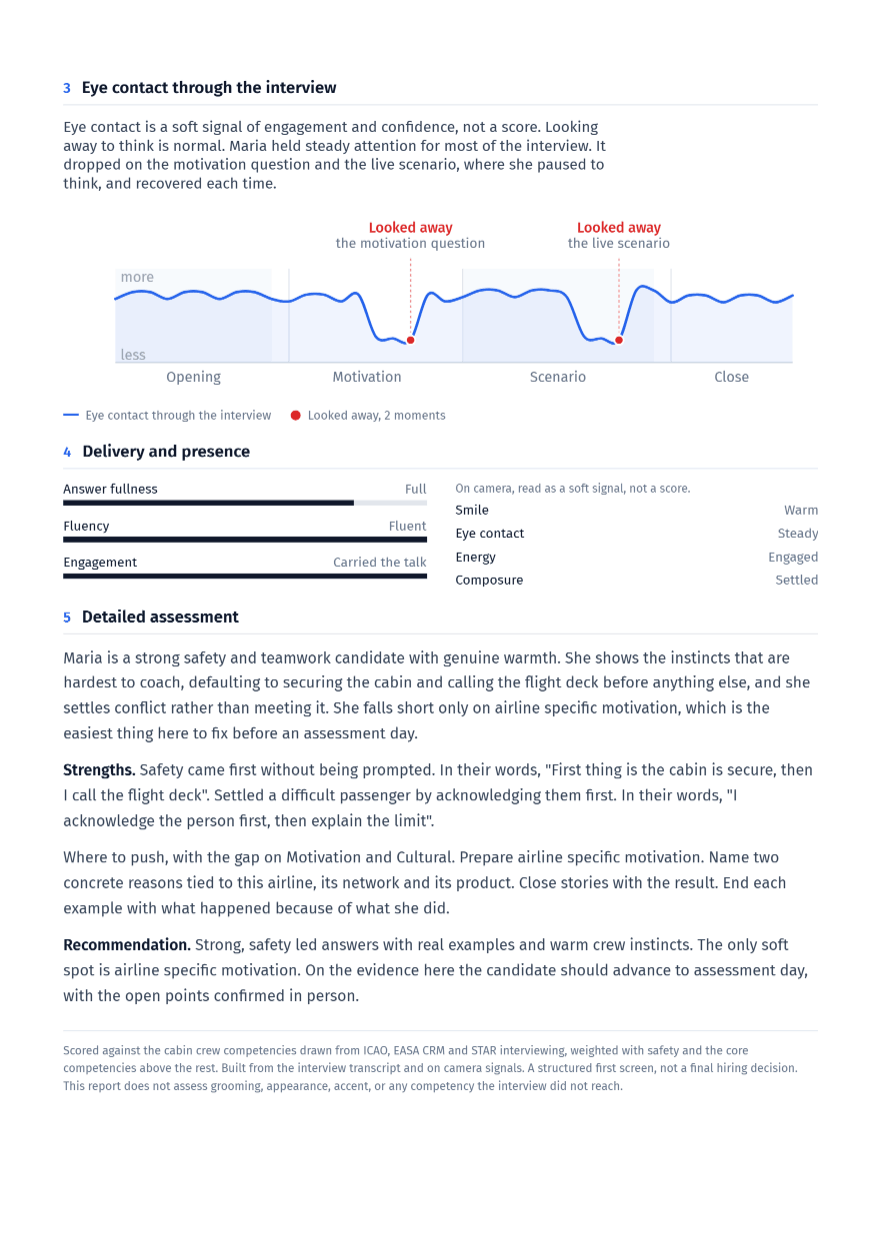
Interview research is clear: eye contact, facial expression, posture, gestures and vocal steadiness shape how confident, warm and credible an answer feels. Cabin crew interviews look for composure as well as judgement, so Avienne helps you rehearse the answer and the way it lands.

Eye contact and listening. Do you look engaged while listening and return to the interviewer naturally when making your point?
Expression and posture. Does your face and body language match the warmth, calm and professionalism expected from crew?
Voice and pace. Are you clear, steady and easy to follow, especially when the question puts you under pressure?
Gestures and fidgeting. Are your hands helping the answer, or are nervous habits pulling focus away from it?

The goal is not to act perfect. It is to make sure your delivery supports the answer you worked hard to prepare. The same STAR example can feel ready or unsure depending on whether you look present, pause cleanly, hold your posture, and finish without rushing.

Eye contact and listening

Strong: you keep attention while listening, then return to the interviewer or camera for the important parts of your answer.

Watch-out: looking down through the whole answer, reading from notes, or losing eye contact at the exact moment you make the point.

Head movement and posture

Strong: small nods, relaxed shoulders, upright posture and a slight forward lean make you look attentive without forcing it.

Watch-out: sitting frozen, slouching back, crossing your arms tightly, or shifting so often that the answer feels unsettled.

Facial expression

Strong: a warm greeting, natural smile, and expressions that match the subject: caring in service answers, serious in safety answers.

Watch-out: a fixed smile, a blank face, or smiling through a serious example where the interviewer needs to see judgement.

Hands, gestures and fidgeting

Strong: visible hands and small purposeful gestures that help structure the story, compare options, or underline the result.

Watch-out: tapping, clicking a pen, touching your face, adjusting clothes, or hiding your hands for the whole interview.

Voice, pace and pauses

Strong: steady volume, moderate pace, and short pauses before difficult questions so the answer sounds considered, not memorised.

Watch-out: rushing the ending, dropping your voice, speaking in a monotone, or filling every pause because silence feels uncomfortable.

Congruence

Strong: your delivery matches the competency: warm for service, calm for conflict, disciplined for safety, reflective for mistakes.

Watch-out: saying you stay calm while your body looks tense, or giving a caring answer in a rushed tone that feels transactional.

AeroScout focuses on controllable interview behaviours: attention, composure, clarity and presence. It is not about attractiveness or beauty.


The questions candidates usually only practise in their head.

Why cabin crew?

Turn a generic motivation answer into something personal, concise and credible.

Difficult passenger

Show calm service recovery without sounding defensive or scripted.

Safety first

Practise what you would do when a passenger ignores instructions.

Team pressure

Explain how you support colleagues when the cabin gets busy or tense.

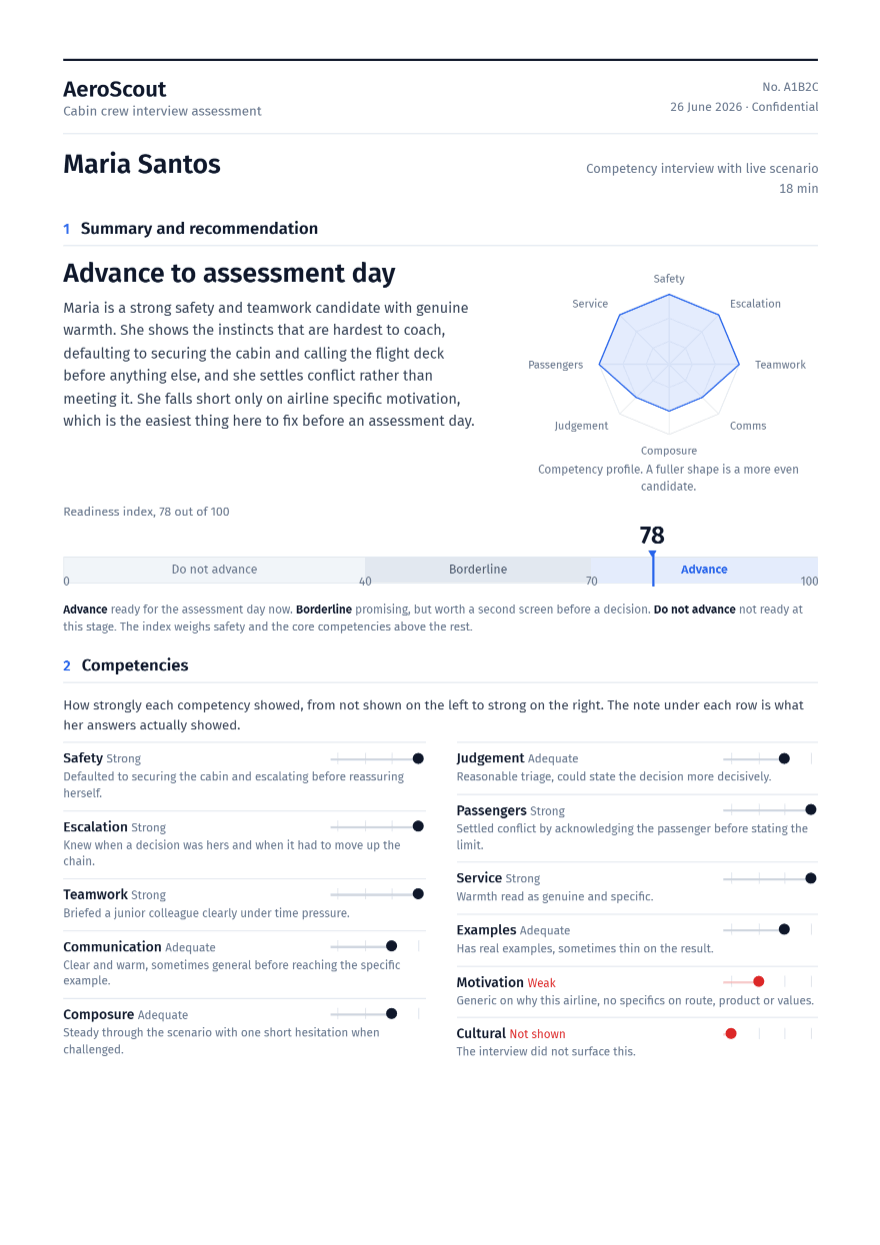
A cabin crew interview coaching report
One coaching report per full interview

Walk away knowing exactly what to improve.

The report is direct but useful: your strongest answers, the moments that weakened your score, what to practise next, and how to make the answer sound more cabin-crew ready.

Competency scorecard. Service mindset, safety judgement, teamwork and communication.
Presence and delivery. Notes on pace, eye contact, posture, gestures and fidgeting that may change how the answer lands.
Watch-outs. Where you sounded vague, rushed, cold, distracted or under-prepared.
Next prep list. The questions to rehearse before your real interview.

Start free. Buy passes when you want the full report.

Each full spoken interview uses one Prep Pass. The free taster lets you try the experience first.

Starter

$25 / 3 interviews

For one upcoming assessment day and a few focused practice rounds.

Choose Starter
Best value

Plus

$39 / 7 interviews

For deeper preparation across motivation, service and safety scenarios.

Choose Plus

Pro

$50 / 10 interviews

For repeated practice before multiple airline applications.

Choose Pro

Questions before you start.

Is it really spoken?+

Yes. You answer out loud and Avienne replies in a real voice. You can end whenever you like.

Do I need to pay first?+

No. Start with the free two minute taster. Full interviews and saved reports use Prep Passes.

Which airlines can I prepare for?+

You can choose a balanced general interview, or an Emirates or easyJet style interview before you begin.

What is in the report?+

A competency scorecard, strengths, watch-outs, delivery notes, and the specific fixes to practise before your real interview.

What if it is not useful?+

If a Prep Pass was not useful, you get your money back, no questions asked.

Your next cabin crew interview should not be the first time you say it out loud.

Try the free taster, then decide whether you want a full interview and report.

Start your mock interview Free taster first. No card needed.